




There are those who have no interest in great human achievement: the kind that lasts, that advances human knowledge, and speaks to the ages. They see a great human structure in much the same way a dog or cat would; as just another object of a different shape and size, and without any interest or intellectual curiosity as to its origins, its inspiration, or its impact on future human thought or development. Often they question the wisdom of great endeavors that cannot immediately be monetized. If the world were led by their likes, we would all still be scratching out a subsistence among the bushes, and dying after thirty or forty brutish years. Fortunately, civilizations and cities do arise now and then that provide fertile ground for geniuses, visionary patrons, and prosperous societies to come together and produce wonders that not only inspire our existence, but elevate our knowledge and understanding of the possible.
For America, the greatest locus of its inspiration and glory has been New York City. And its most dazzling and universally impressive expression has been the skyscraper. Replicated since in all of its other great cities, and then across the world, this uniquely American concept has become a universal symbol of achievement and status, and more importantly, capability. Some scoff at the sight of Arabian and Asian cities scrambling to build greater and greater structures. These same people would have turned their noses up at New York's and Chicago's competitive building frenzy at the start of the twentieth century that led to the creation of the tallest structure built by man in 6,000 years of recorded human history; a competition that advanced human knowledge in the realms of engineering and architecture, and changed the face of our cities across the earth.


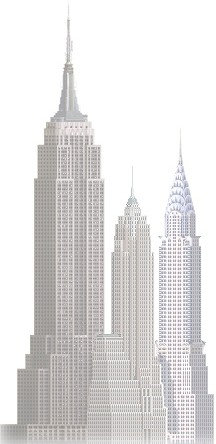
Thus it was that in 1970 everyone knew the world's tallest and most famous building stood at the center of New York City, as it had for nearly forty years. Its spire fittingly crowned, at a quarter of a mile, a skyline that boasted fully thirty-five of the world's fifty tallest buildings (70%, or over twice as much as all other cities of the world combined!), and two-thirds of the top one hundred. A colossal collection of monumental emblems of the city's power and centrality to world civilization, the Manhattan skyline was until the 21st century the world's most massive architectural and engineering feat. Never has a city loomed so much larger than all its contemporary rivals, except maybe ancient Rome. So, when one stood atop the Empire State Building, the greatest building of the greatest city the world had ever seen, one could be excused for feeling one was standing at the center of the world - literally the physical apex of human civilization.
But soon the center of the world would begin to dissipate. A few miles across town, on that gray, twenty-first day of October of that year, workers were busily arranging glass, steel and concrete into orderly lines and planes that would eventually rise 1,368 feet by the end of the year. With the completion of the north tower of the World Trade Center in 1972, the crown title of New York officially moved from the center of the city to its edge, as if it was about to depart. It soon did.