
Main
Index of the Weekly Forecast & Review
Ultrapolis
Weekly Forecast & Review – Special Edition
Wednesday, February 24, 2010
© Copyright 2010, The Ultrapolis Project – May be used freely with proper
attribution. All other rights reserved.
Update to Ultrapolis Project’s
World’s Tallest Cities Rankings
The following article is an adaptation of new page
added to the UltrapolisProject.com permanent section on the World’s Tallest
Cities. The World’s Tallest Cities section tracks skyline construction trends on
the premise that those trends are a physical manifestation of future global
economic changes and power shifts that will eventually affect international
relations and America’s preeminence in the world, just as they did at the start
of the last century. This section is our
most popular, and has become the accepted definitive world-wide source for this
specific type of ranking - cited as a reference by websites in a variety of
languages, including numerous citations by Wikipedians of different
nationalities editing articles on cities.
Thousands visit this section every month. The article below is a new page added to this
section, in light recent developments dramatically affecting our ranking
results for 2009 and 2010. You may visit
this section at http://www.ultrapolisproject.com/ultrapolis_017.htm.
Dubai
Becomes World’s Tallest City, Supplanting Chicago
Dubai Skyline a Manifestation of Larger Global Changes
From Desert Village to World Super City
The story of the modern great city of Dubai is a new one. Of the great cities of the world, Dubai is a newcomer, and a relatively small one at that. Of the ten tallest cities of the world, it is easily the smallest in population by any measure (city proper, metropolitan area, or urban agglomeration). Of the cities of the world, it does not even come close to the top 100 in population size. As of 2009, estimates put Dubai's population at around 1,700,000, including its adjacent urban areas. By comparison, the metropolitan population of the next smallest of the other ten tallest cities is over twice that, and the largest of those, New York City, is at over ten times the population.
What is more remarkable is that Dubai, as recently as the 1950's, was a desert hamlet of only about 20,000 people. Up to this point in history, only the largest cities of the wealthiest nations could produce an architectural landscape on the scale of Dubai. Prior to the 1990's, Dubai did not have a single significant skyscraper. Its tallest building, built in 1982, had 23 floors. As recently as the year 2000, New York City's last full year as the world's tallest city, Dubai still did not even rank among the top 25; but by then now its building boom was picking up speed, and already sported its first 1000+ foot skyscraper.
Today, Dubai is a financial center of investment capital on a par with London, Paris, and Hong Kong, and attracting more capital annually than New York City. It is the global transportation hub of the Middle East. It has ensnared America's top leaders with business scandals (former President Clinton in a business partnership that in 2006 tried to gain control of major American ports, and then U.S. Vice-President Dick Cheney's when his former company of Halliburton chose it as its new headquarters to escape U.S. taxes).
Fortunate City Looks Forward and Up
The first blessing for Dubai was being in the fortuitous position to share in the tremendous transfer of wealth of from the advanced Western countries to the then-poor, but very oil-rich kingdoms of the Middle East. This transfer of wealth of what amounts to literally TRILLIONS of dollars is one-of-a-kind in history. In 2007 alone, estimates put the number at $700 billion dollars. And this transfer of wealth has been taking place since the 1950s.
The second piece of good fortune was that this began in the middle of the 20th century. At any other point in history, where a dominant power found vast quantities of a highly desired natural resource in the hands of a much weaker one, it simply conquered and took what it wanted. At best, a small power could only hope to accept whatever price its overlords set. This was true from the Babylonian Empire to the British Empire, up until World War II. But all this good fortune, by itself, could still have resulted in waste and missed opportunities, as it has in Nigeria and Venezuela, or in a more conventional approach of public spending, as with Saudi Arabia, or Dubai's fellow emirates. What was different - the third blessing - was Dubai's ruling family that looking to the future, sought to develop an economic base that went beyond oil. This approach was then turbo-charged by Sheikh Mohammed bin Rashid al Maktoum, who was appointed Crown Prince by his brother in 1995, and acted as de-facto ruler in more recent years until his outright ascension to the emirate's throne in 2006.
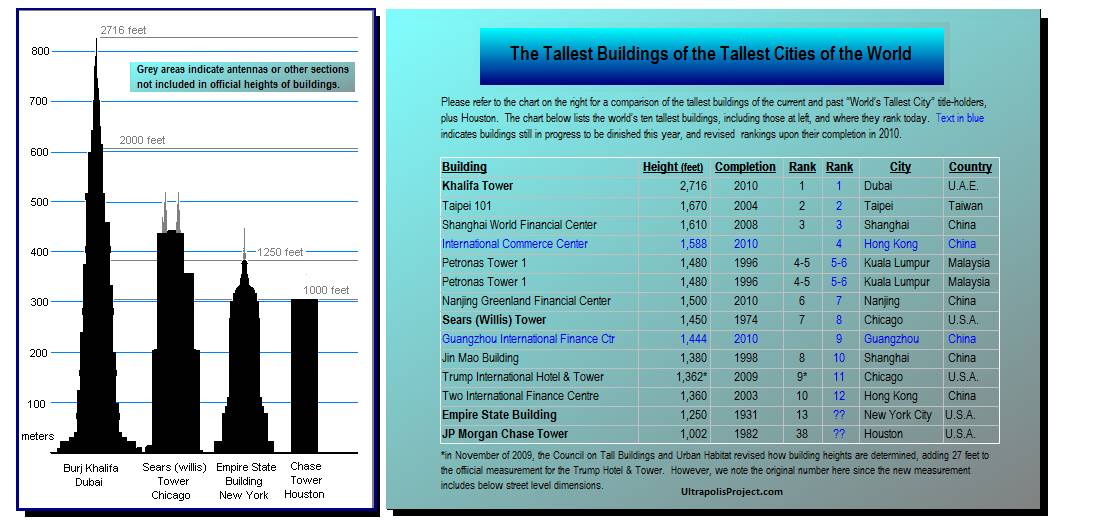
His efforts led to Dubai's fantastic island cities in the shape of a palm tree and a world map, an underwater hotel, a mall with an indoor snow-ski slope, and of course, a gleaming skyline second to none, topped by what is by far the tallest building in the world. Since 2000, Dubai has built six buildings as tall as or taller than Houston's 1002-foot Chase Tower, and another twenty at 750 feet or more. That's a whopping twenty-six (!) 750-plus-foot buildings in ten years. In that same time frame, New York City has built seven, and Houston none. And of course, Dubai's brand-new glass skyline rising out of the Arabian desert sands includes the just finished 2,716-foot high Burj (Tower) Khalifa building, the world's tallest by almost a factor of two. Two Empire State Buildings stacked on top of each other would still fall short of the Burj Khalifa. With the formal completion of the tower on January 4, 2010, its inclusion in our CAHTT* score put Dubai at the top of our World's Tallest Cities ranking, taking the title away from Chicago (see the World's First Tall City page), and will likely retain the top spot for years to come. Once again, Chicago goes back to second, after first ceding the spot to New York City at the start of the 20th century, nearly 100 years ago, and then again briefly to Hong Kong in 2008. (New York is now ranked 5th.)
*CAHTT
– Calculated Average Height of the Top Ten.
See our Methodology
page for details.
Tower Meant to Celebrate Dubai, Instead
Honors Abu Dhabi
For all its glitzy displays of wealth and new favor among the jet set, for all its unusually open cultural atmosphere for a Middle Eastern country, upsetting some of its neighbors, Dubai still retains many of the old ways. It is still a true monarchy, and still holds on to some very un-modern attitudes shared by fellow Arab countries. For one thing, though it may not always enforce it, it has laws that call upon it to deny entry visas to Israelis, or those with Israeli stamps on their passports. This caused major international problems last year when Dubai denied a visa for Israel’s top tennis star, Shahar Peer, who was expected to take part in an international tennis tournament held there.
And, of course, as we first asked back in 2006 when releasing our 2005 rankings, the question is how a city of Dubai's scale will fill a skyline that is usually found in a city several times its size. If Dubai was hoping for continued growth at record pace, the global economic downturn that began in late 2007 has brought that to a halt. Commercial real estate prices in Dubai have fallen 50%-75%, leases and constructions projects have been cancelled, and laid-off foreign workers have returned home. The financial crisis really hit home with Dubai in 2009, when it had to ask its fellow emirate Abu Dhabi (capital of the U.A.E.) for emergency aid to service its debt. In apparent gratitude (or servitude), what was going to be the Burj Dubai was renamed the Burj Khalifa, after the emir of Abu Dhabi, Sheikh Khalifa bin Zayed, also the current president of the U.A.E.
So, maybe it is fitting that in a sense, Dubai's intended icon of its new ascendancy among the world's top cities is now a symbol of its current financial and political precariousness. Nonetheless, the setback is likely temporary (the Empire State Building was finished at the start of the Great Depression, and was called the Empty State Building in its early years) and the rise of the stratospheric half-mile tall Burj Khalifa and the rest of the Dubai skyline, along with others across Asia, are certainly an amazing wonder to behold. But unlike an illusion in the desert, these are more than a fantastic mirage, they are a message - a message Americans would do well to heed.
Iran on Zigzag Path to Atomic Bomb – Part II
U.N. Nuclear Watchdog Agency Says Iran May Well Be on Path to
Bomb
In our February 10, 2010 weekly report, we warned that Obama and the West notwithstanding, nothing “will stop Iran’s leadership from pursuing a policy that will get them ever closer to developing, and ultimately deploying, nuclear weapons.” On February 19, the International Atomic Energy Agency (IAEA), responsible for monitoring efforts at developing nuclear power and armaments, declared that it had serious concerns that Iran is enriching uranium for the purposes of creating a nuclear payload to be delivered by missile. The Obama administration, however, said it stood by American intelligence assessments that Iran has halted its weapons program, though it did not refute the IAEA report outright.

Main
Index of the Weekly Forecast & Review
© Copyright 2010, The Ultrapolis
Project
May be used freely with
proper attribution. All other rights
reserved.